[This is Part 4 of a multi-part series on a "Simple Approach to the Run and Shoot." In one sense I mean "simplified," but the series is, more than anything else, intended to both diagnose and explicate some of the fundamental concepts behind the shoot as well as discuss how I might marry them with some passing modern ideas, all in an effort to just understand passing offense generally. You can see the full series here. Also check out Parts 1, 2, and 3.]
It's been a bit since my last installment, but I'm not quite done, as there are two concepts left in the fearsome foursome of the 'shoot. This foursome includes: go, choice, and now streak and switch.
These two plays really do not involve any new learning, and although considered separate plays, they really are two sides of the same coin: four verticals, which I analyzed recently with Dan Gonzalez. I begin with "streak." The switch will come in the next installment.
Streak
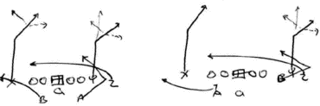
At core, streak is just what the run and shoot guys call "four verticals." And four-verticals is a very simple concept that is so powerful because well designed pass plays boil down to elementary math: geometry and arithmetic. Four receivers bolt down the field, and if they keep the proper spacing between them -- by staying on their "landmarks" -- the defense will be outnumbered and can't properly defend the play. Against Cover Two, well, the defense only has two deep (hence the name) while the offense has four receivers deep. With cover three, well the offense still has a man advantage. And, again, if the spacing is correct, the offense can even whittle it down so that they know who they are operating against, namely, the deep free safety.
But this doesn't mean that the defense is without options. They can disguise coverage, play different techniques, or quite simple play four deep -- four on four gives the advantage to the defense. (Contra Ron Jaworski, creating favorably one-on-one matchups lags far behind creating favorable numbers advantages, i.e. two on one defend.) In response, the run and shoot, as usual, gives them freedom. Hence, the "seam read" all over again.
As the diagram above shows, the four receivers all release vertically. But the coaching points are critical:
The outside receivers will release on go routes. The "frontside" one (in the diagram, the one on the offense's right) has a mandatory outside release: he will keep pushing to the defender's outside hip. That said, he still wants to keep five yards between him and the sideline, to give the quarterback a place to drop the ball into.
The slot receivers release up the seams. But they must be more precise than that: in college, they must be two yards outside the hashes; in highschool (where the hashmarks are wider), they must be on them. This spacing is the most critical element of the entire play: it is what makes it geometrically difficult for the deep secondary to cover.
The runningback might be in the protection, but if he releases he will run either a drag across the field or a little option route underneath. He looks for an open spot in the zones as an outlet if the undercoverage releases for all the receivers, and against man he will cut in or out. He should be working against a linebacker and can't let that guy cover him.
The outside receivers, if they can't get deep, will break the route down and "come down the stem" -- retrace their steps -- to get open later. The QB, if the initial reads are not there, will hitch up and throw them the ball on the outside.
But the key to this play, as it has been for all four of these "core" run and shoot plays, is the seam read. I previously described this route in detail, but in sum: against a defense with the deep middle of the field "open" (cover two), the receiver will split the two safeties on a post route; against middle of the field closed (cover 3, cover 1), with a single deep middle safety, the receiver will stay away from him and continue up the seam. In that sense the route is a lot like the divide route I've discussed before. But the route is more dynamic: if the safeties stay very deep, or any defender crosses the receiver's face, he will cut inside or underneath those defenders to get open.
Below are a few clips courtesy of Michael Drake again. In this first video the quarterback, though a bit slow, hits the seam read.
On this second video, the defense is in a blitz look. (Sort of Cover 1 with a "rat" or floater, though no deep safety.) The receiver probably should have crossed the defender's face, but they are able to complete it.
And below is a clip of four-verticals where it gets dumped off to the runningback.
Finally, below is video of Texas Tech running the play (courtesy of Trojan Football Analysis). I end with this both because Tech of course is not exactly a run & shoot team, but also because some of the variants shown on the video -- particularly the shallow cross -- are things a lot of R&S coaches have gone to, including June Jones.
So when I started watching this, which is one of those hokey Sports Science comparisons between a pro athlete and some rather arbitrary metric, I thought there was no way that Drew Brees was more accurate than a world-class archer. Well, I was very, very wrong. Watch below. (Brees's throwing picks up at about the 4:10 mark.)
The shallow cross route is not a new topic for this site. Just the other day, in discussing Trojan Football Analysis's great breakdown of how Georgia's Mark Richt runs the route, I mentioned some of my previous discussions of the route itself as well as some of its common combinations. Those links can be found here, here, here, and here. Also check out the "jerk-route" variant. When teams began to go to the spread years ago by replacing tight-ends and fullbacks with wide receivers, they needed something to do with those wideouts. The shallow became an obvious answer for several reasons: (a) with fewer pass protectors, a quick breaking built-in "hot" route (over the middle no less) is exceptionally useful, particularly since the receiver breaks right in front of the quarterback for an easy throw, (b) the shallow keeps consistency with route concepts designed for two-back sets because the receiver simply replaces the runningback's role as an underneath outlet in the progression, and (c) especially in the spread's early days, defenses tended to cover these extra receivers with linebackers who were ill equipped to chase a receiver for twenty or thirty yards, even if the direction was lateral and not vertical. (The route has some limits: it gives easy cues for pattern reading by the defense.)
There's a couple variations in how the shallow is used. Typically, a shallow route is combined with some kind of ten to twelve yard square-in route behind it. The question is from which side does the square-in break from: is he coming from the same side as the shallow -- i.e. trailing him? Or is he crossing over the top? This matters because it makes a big difference between what kind of flow you're looking for from the linebackers and where the windows in the zone will be. The Airraid guys tend to have the two guys cross and head in opposite directions. the diagram below.
(Image courtesy of Bruce Eien; check out more notes on their version here.) For clips of this version of the concept try here and here. It's a great concept: the shallow pulls the linebackers while the square-in -- aptly known in Airraid terminology as a "hunt route" because the receiver "hunts himself a good place to settle down" -- find the void between defenders.
I am concerned in this post, however, with an older version of the shallow. This is the "drive" concept, made popular by Bill Walsh as a way to get his flanker or "Z" receiver (Jerry Rice, hello!) the ball running full speed across the formation. Secondarily, if they covered Rice there was usually a big window in which to throw the ball to the tight-end. Below is a diagram of how Walsh ran the play from several different sets, straight from an old 49ers playbook.
First, a few features of Walsh's version. Keep in mind a very basic fact that many NFL announcers do not understand: The slant and the shallow are not the same play. On the slant, the receiver takes between two and four steps upfield (I prefer three, beginning with the outside foot back) and then a 45 degree break. The quarterback takes a three-step drop and delivers it quickly. The shallow, on the other hand, takes awhile to develop. The quarterback takes a full five-step drop (and sometimes seven, or five from shotgun) and waits for the receiver to at least cross the centerline. Again, it was Walsh that helped systematize these plays, though they preexisted him.
Anyway, his "drive" route, as he called it, begins with the shallow. Walsh often motioned his flanker towards the formation to enable him to explode through all that man-traffic so he would hopefully emerge free and clear on the backside. If the defense was in was man-to-man -- especially loose man-to-man -- the cornerback usually had a hell of a time trying to catch up with the receiver. But if the defense did cover that route, the tight-end was responsible for finding the void in the zone. The final read was the runningback as an outlet.
But, before getting to those routes, the quarterback always retained the option to throw deep to the corner route or the "go" route on the backside; typically this was the case if the defense was in man to man and he saw a matchup he liked. Note how Walsh sometimes had the corner route run by the halfback in the backfield -- think of Roger Craig or Ricky Watters with a linebacker assigned to him. Alternatively, sometimes the cornerback and near safety were so concerned with the flanker and tight-end that they collapsed down, leaving the runningback or slot man to break wide open on the corner. Nowadays, many modern teams send the runningback on a "wheel" route -- i.e. begin the route like you are running to the flat on a "shoot" and then turn and "wheel" it up the sideline. Below is a variant Bobby Petrino has used in the past at Louisville, the Pros, and now Arkansas.
So where are we now with the play? There have been a few changes in how most teams use the route and concept, especially since now that so few teams base out of two-back sets. As a result, the shallow is seen more as a route for inside receivers than a way to throw it short to your flanker. Below is a diagram of one of the modern versions (as you can see, quite similar), explicated in rich detail in Dan Gonzalez's book, Concept Passing: Teaching the Modern Passing Game. Gonzalez calls his route concept "drag."
So the basic route structure is the same as Walsh's drive. The major differences are that interior players are used, that the outside receiver to the trips side is given a post route to exploit a safety who might play the square-in too aggressively, and on the backside the X is a greater part of the play.
The quarterback isn't always told to read the comeback, but if he does he keys the outside linebacker to that side. See the diagram below, the man circled in blue. If the linebacker drifts where he is or takes the shallow coming to him, the quarterback can drill the ball to the comeback on the outside. If the linebacker heads quickly to the flat to take away the comeback, the shallow route should come wide open in the void he has vacated.
The rest of the play works just like Walsh's drive: either the shallow or the square-in should come open depending on who the linebackers pay attention to, and if neither is open the runningback should be open. Below is footage of the play, thanks to Dan Gonzalez and Mav (first clip), and Bruce Eien (second clip). Bruce's differs slightly but is similar enough to be grouped into the same family.
and
The film by Eien, directly above, is basically a cross between the true, old school "drive" and the Mark Richt/Florida State version, which again is the same "drive" concept but applied to a more two-by-two setting. For more on Richt's version, check out Trojan Football Analysis. Below is a diagram and cutups of the concept as another comparison.
Conclusion
As evidenced by my old post on how Mike Martz used the route, the shallow's usage is limited only by the imagination. It can be the primary route, the hot route, or a secondary route for the quarterback to come to late in his progression. It can be run by any receiver, and can be part of a main concept or used in some auxilliary way. But however it is run, it is still one of the best ways to get the ball to a playmaker -- speed in space -- and so long as teams keep spreading their formations, they will keep using the shallow cross.
Bonus - Video below of Mike White, then head coach of Illinois, explaining the now-Airraid version of the shallow cross. His quarterback at the time was Jack Trudeau. After diagramming the play White shows the square-in or "hunt" going for a big touchdown against one of Bo Schembechler's Michigan teams.
[Ed. Note: Extra thanks to the guys at the Huey Board for some of the diagrams and info, in particular Mav.]
The Ryan Leaf saga has taken its most tragic -- and possibly final -- turn:
CANYON, Texas (AP) -- Former NFL quarterback Ryan Leaf has been indicted by a Randall County grand jury on drug and burglary charges.
The indictment handed up Wednesday in Canyon charged the 33-year-old former San Diego Chargers quarterback and former West Texas A&M quarterbacks coach with one count of burglary to a habitation, seven counts of obtaining a controlled substance by fraud and one count of delivery of a simulated controlled substance.
The indictment said Leaf presented an incomplete medical history to several physicians between January 2008 and September 2008 to get or try to obtain the painkiller Hydrocodone. . . .
Canyon police Lt. Dale Davis said Leaf is suspected of breaking into a Canyon apartment on Oct. 30 and stealing Hydrocodone, which had been prescribed to an injured football player. . . .
"We have not found any evidence implicating anyone other than Mr. Leaf in this case ... but believe there's additional evidence implicating him in other events," [Randall County district attorney James] Farren said. He would not elaborate.
(H/t Dr Saturday.) Leaf of course was a world-class bust in the NFL, as much for personality reasons as for physical ones. But in college, he was a beast: He led Washington State to a 10-2 record and a Rose Bowl appearance, he threw for 3637 yards (over 330 a game), and 33 touchdowns. (Team stats here.)
And, particularly in historical perspective, that Washington State offense was dynamic. Mike Price designed it based on, in part, by what he had learned from Dennis Erickson's one-back attack at Washing State and elsewhere. Indeed, this one-back offense was one of the predecessors for the modern spread attack, both in terms for passing and running. Mike Leach and Hal Mumme visited Price to learn his offense before they went on to break every SEC passing record in 1998, and Price shared his offense's precepts with coaches like Purdue's Joe Tiller, who had also worked with both Price and Erickson.
Price, of course, experienced his own rise and fall. He was hired to coach at Alabama and, after some kind of stripper-scandal (aren't all the best scandals stripper-related?), was fired before his first season could even commence.
But, for a time, especially in 1997, the two, Leaf and Price, coach and quarterback, combined to put on a show worthy of the sliver of immortality reserved for all such successful seasons. In this post I will give a brief overview of the theory behind the Washington State offense that year. Mike Price liked to joke that he could explain it in five minutes on the back of a napkin. An exaggeration, but not much of one.
The Washington State one-back
Price employed a lot of formations that year, but they used the "double slot" the most: two receivers to either side of the quarterback along with one running back. Many now will recognize this as the basic spread formation (though Leaf was usually under center rather than in the shotgun), but back then it was somewhat of a novelty still. Price used it because of its then relative rarity, but also for practical reasons: Washington State's fourth wide receiver was better than its tight-end.
The basic theory behind the offense is the one that has been adopted by almost all spread teams: count the safeties, identify how many defenders are in the "box" to decide whether to run or pass, and call your bread and butter stuff until defenders get of of position, then when they do hit them with the constraint plays like bubble screens or play-action. As my article on Urban Meyer's offense explains, Meyer's offense follows the same basic pattern.
To begin with, assume the defense has just one safety back. That means that, if they cover all the receivers, the defense has only six guys in the "box" -- i.e. the interior defenders. The offense has only five blockers, and Leaf was not much of a threat to run. They did however have good matchups on the outside. So the first thing WSU looked for was the leverage of the cornerbacks: were they playing soft or tight? If they played soft, Price (or Leaf via audible) would call a quick, five-yard hitch to the outside receivers. Leaf needed only to pick the best matchup and fire the ball out there. Let the receiver catch a quick one, make a defender miss, and make a big play.
If the defense played "tight," however, Price and co. dialed up one of their "option routes." The outside receivers were to run deep and try to get open deep (which happened with some regularity, as the highlight against UCLA above showed). The inside receivers were to burst upfield to eight to twelve yards depending on the call. Against man-to-man, they cut inside or outside depending on the defender's leverage; against zone they found a hole between defenders and settled in it.
What if the defense put two safeties back, to guard the deep pass and play the receivers tight? Well, then it only had five in the box, so it was time to run the ball. In 1997, Washington State had a good running back, Michael Black, who ran for over 1100 yards in 11 games.
And that pretty much covers the bases. Where it gets trickier is when defenders try to "cheat" -- and that's when you get into the constraint plays. First, the defense might line up with two safeties back but the outside linebackers over the slot receivers will cheat in to stop the run. In that case, the offense can throw the bubble screen.
Alternatively, the inside linebackers or the outside linebackers might cheat in or be watching the run, so that's when the bootleg is often effective. The quarterback looks to hit either the man in the flat or the slot on the deep crossing route.
Finally, if the safeties want to cheat up, well then it is home run time. The quarterback will fake it to the runningback and run the four-verticals concept or another deep attacking play.
That's really about it. an incredible amount of their offense was spent just cycling between that sequence. And Leaf, at least that year, showed a great propensity to read defenses and make the right read on passing plays. But obviously he was helped by having a smart, simple framework to work from.
Other applications
Of course there are other concepts worth mentioning briefly. One was Price's version (or one of his versions) of the shallow cross. Price combines the shallow with the deep cross. The quarterback reads the play by first looking at his deep routes as his "peek" or "alerts" -- i.e. if the home-run is there, take it. If the go and the post aren't open, the shallow cross is "hot," against a blitz, otherwise he can read the deep-cross as his "high" read and the runningback as his "low" read. See the diagram below.
And you can see Leaf hit the deep-cross or "hunt" player against Michigan in the Rose Bowl, with heavy pressure in his face.
And another nice route is what Spurrier called the "Mills" play. It is designed to either be a simple curl-flat read, but with a post route over the top of it. In a lot of coverages -- especially four-deep across -- the safeties play very aggressive, and will jump routes in front of them. This gives the play its big-play potential: if the safety jumps the curl, the post route is wide open behind the defense . . .
. . . and that is exactly what happened in 2002 when Washington State played Pete Carrol's Southern Cal team. (Washington State upset USC, led by Carson Palmer, and probably cost them a shot at the national title game. WSU's quarterback was Jason Gesser, though Price was still the coach.) See the video below.
Conclusion
Exceedingly simple, but those were the spread's gestative years. Maybe history would be different had Price managed to stick around at Alabama, and brought his unique one-back to the SEC before Meyer had set foot in Gainesville. (Though Price's subsequent years at UTEP haven't been spectacular.)
But the larger point is that football, especially in modern times, offers some degree of immortality for those who succeed. Leaf's more recent infamy as NFL bust and low-level criminal will now never leave him, but his full record will always include 1997, when there was no better triggerman in the Pac-10 -- maybe the country. He didn't have an all-star cast around him, just some shifty, tough guys, a well-designed playbook, and the confidence, maybe arrogance, to be great, even if only for a time.
The NFL Network has a nice video on a play the Broncos used to beat the Chargers here. (Sorry no embed capability from the NFL site, apparently.) The focus there is on the so-called "jerk" route, where the shallow cross receiver fakes like he is going to settle in the zone hole but then continues. (I'm not so sure that this isn't a read for that receiver, but in any event you'll get the idea.)
Readers might however find interesting the extended discussion of the concept I previously wrote up here. It is known as the "angle" or "follow" concept. In other words, although the Broncos throw it for the touchdown and conversion to the same guy, the quarterback's secondary reads are to the corner route and the receiver who begins like he's running to the flat but then pivots and comes back inside. The Broncos also use a corner route to the other side as well, unlike the post route I have drawn up in the diagram, above.
[Ed Note: This is Part 3 of Manny Matsakis's series on his "triple shoot" offense. Check out the triple shoot website here.]
Part 3 - Passing attack and screens
The drop-back passing game is initiated by our QB taking his drop to the inside hip of the play side Tackle (6 yards deep) while receivers are running route adjustments based on the coverage they are going against. We throw the ball out of a normal snap formation or a shotgun alignment. Throws are made to the receivers based either on “looks” or “reads”. A “look” is a progression from one receiver to the next, based on who should be open in sequential order. A “read” is the process of a QB reading the reaction of a specific defensive player (depending on the scheme that has been called), which in turn he will throw off of that defender’s movement.
Our drop back passes are all scheme-based as opposed to receiver’s running a passing tree. When a scheme is in synchronicity receivers will break on their adjustments as they are moving on the stem of their routes. Our receivers are trained to know what coverage they are facing by the time they are into the third step of their route. In the past, we would make a pre-snap determination of the type of coverage and execute routes accordingly. The benefit of our current system is that it is impossible to disguise coverage this late into the play. Regarding coverage recognition, this is taught by quickly assessing which family of coverage the defense is playing and then “feeling” our way to the appropriate breakpoint. This sounds much more difficult than it really is and we have developed specific drills that make this as easy as playing sandlot football.
Pass Schemes
There are six primary passing schemes which all “route adjust” based on the coverage we are facing. We can run many of these out of Even or Trips formations and we can even motion to Trips to change up the look we give defenses. The base schemes are called, Slide, Scat, Choice, Hook, Curl and Outside. Each scheme is named after the route run by the outside play side receiver. In every practice, we work on every scheme versus all coverage adjustments. “Tiger” Ellison once told me, “If you can’t practice the whole offense in a single session, you are doing too much.” Since the day he told me this in 1989 I have followed his advice to never add something without taking something away.
To write about all these schemes and adjustments would take a book or an instructional video. To give you a taste of the offense, let me share with you the top two schemes we most enjoy running, Slide & Choice! Slide has evolved from what “Tiger” Ellison called the Frontside Gangster and Choice comes from what was originally called the Backside Gangster.
Slide
The Slide scheme is the basis for all the passing game, in that we use this as a drill to teach 80% of our passing attack. The reason for this is that the route adjustments in Slide are executed at some point in the other schemes to a great degree as the QB rolls to the three-receiver side of the formation.
It all begins with the Slide route (In trips) versus a Nickel look (Cover 3 or Man-free). This route starts off with an outside release for 3 steps and from that point the receiver will read the coverage of the defender over him (Cornerback). If the defender bails out, the receiver will execute a Post on his 7th step. If he is playing a man look, the receiver will proceed to run a fade on this man to beat his man deep.
The #2 receiver will run a bubble route around the numbers on the field, making sure to look inside at the QB at a distance of 1 yard behind the line of scrimmage. The #3 receiver then executes a Pick route. The Pick route is designed to get over top of the outside linebacker that is covering the inside receiver. As he gets over the top of that linebacker, the receiver gets to a depth of 12-14 yards before he applies his “downfield zone rule”. The “downfield zone rule” is applied on the free safety in the following manner, “if the man in the zone is high over the top, the receiver will raise his outside arm and set it down to find the passing lane to the QB”. “If the man in the zone crosses the face of the receiver, the receiver will then run a thin post and expect to score.”
The QB will read the Slide route and throw it if it is open, if not, he can then check to the bubble and finally look to the Pick route, which has had the time to get open.
Choice
The Choice scheme is the way that we attack the single receiver side of the formation. The QB starts a roll toward the single receiver and the key to this route is that the stepping pattern of the QB must match up precisely with that of the receiver. The single receiver will release off the line of scrimmage and read the man over him (Cornerback) on the receiver’s 5th step. On that 5th step, if the man over him has bailed out he will run a “speed cut” Out on his 7th step. If the receiver has closed the cushion and the cornerback is outside leverage on the receiver, he will run a post and if he is inside leverage he will adjust his route to a fade.
On the backside of Choice, the three receivers will spread the backside of the field. We run a Go route by the #1 receiver (up the sideline) the #2 receiver will run a “backside stretch” inside the hash mark and the #3 receiver will run a control route at a depth of 5 yards to find a passing lane to the QB.
The QB will read the front side of Choice and throw it if his man is open, if not, he will look backside to the Stretch, then the Go and finally to the Control.
The Choice scheme is a great way to spread the field with our receivers and get the ball into the open seams on the backside, especially if the front side is cloudy.
[Ed. Note: For more on the "choice" concept, see here.] Exotics
The Exotic plays are of two types, either a Screen to the Superback or a Convoy to one of our receivers. They are both set up with a pass protection simulation and we generally leak out three offensive linemen to block up field as the QB will influence the defense with his pass-action roll before throwing the ball to the back or the receiver.
Super Screen
This screen is a pass thrown to the back out of the backfield. Our line blocking is as follows: The front side tackle will influence the Defensive End for a 2-count before coming up field to block the first linebacker he sees inside. The play side guard will step to the direction of the screen and then release to block the support player while the Center will snap the ball and go down the line to block the first threat he sees, if there is no threat, he will turn around and block any defender that may be chasing down the screen.
The Superback must really sell this play by engaging the Defensive End momentarily before settling up in a passing lane behind the line of scrimmage. Our QB will either shovel the ball to him or pop it over the top of a defender depending on the rush of the defensive line.
Convoy
Our Convoy has been successful because the action of the QB is rolling away from the direction that he ultimately throws towards. The blocking scheme for Convoy works in the following manner: Our backside tackle will use a draw technique on the Defensive End and stay on him all the way in order to clear out a passing lane backside. The backside Guard will step to the direction of the QB roll and then release backside to block the support player. Our Center steps to the side of the QB’s roll and then releases backside to block the first linebacker he sees on the backside. The front side Guard will step to the QB roll before releasing backside to get the first man he sees, if there is no threat, he will turn in to block anyone that may be chasing down the receiver carrying the ball.
A convoy receiver will take two steps up field before coming behind the line of scrimmage and down the line into the passing lane for the QB. He will catch the ball and get up field to gain yardage through his linemen’s blocks.
Tomorrow, I conclude with a bit more on my background and the Triple Shoot's history of success.
Heard an anecdote relayed from Oklahoma State's offensive coordinator (good coach, entertaining speaker). He was talking about the four verticals concept, which I and Dan Gonzalez recently explored in depth.
As Dan explained, the key to this whole concept is the "seam-reader" -- the slot receiver who reads the deep coverage and can run a post, seam, or square-in. And as I explained, even if you don't give that player a full panoply of options, at minimum you tell one slot guy to read middle of the field open (two deep safeties) or closed (one deep): against middle of the field open the guy splits the safeties to streak down the middle void; against middle of the field closed the receiver stays up the hash to put the free safety in a bind between the two slot players.
In Okie State's terminology, they call this player the "beater." One thing Dan and I didn't talk much about was how do you decide which guy you want to be the "beater" or "divide route" -- the "get open" guy.
The first diagram shows it with the slot:
And the second shows it with the tight-end here (it could also just be the other slot):
So how do you choose who you want running it? Typically, as Dan draws it up, he likes his best receiver to line up in the slot and to drill that down. You also can do it just to the field: if the ball is on one hashmark you can have the receiver to the wide side run it because he has more freedom.
Brewer addressed this question, and talked about that for him it is often a matter of personnel. Specifically, if you get in three-wide gun (as Okie State often is), the defense often subs in a nickel defensive back for a linebacker. But the problem there is that the defensive back is better than the linebacker: he doesn't go for all the fakes and moves that the seam-reader or "beater" player uses to get open.
To illustrate what they did he told an interesting anecdote. Brewer used to be an assistant and offensive coordinator at Marshall back in the Bob Pruett days, where he coached Chad Pennington (and some guy named Randy Moss). They decided to run the "beater" to the side where the linebacker was and away from the nickel back.
But the problem was that the other teams would often shift this. Fortunately, Pennington was a pretty bright guy, so they let him determine who was going to be the beater pre-snap.
And how did they communicate it? Pennington would get to the line, turn to the side where the linebacker was and not the nickel defender (and hence the also the slot he wanted to run the "beater"), and would just clap in that general direction. Everyone knew what it meant, and off they went.
Some readers sent me an email about their new site, MarkUpVideo. It lets you upload clips or pull them off youtube and add various "markups" and even string multiple clips together. As an example, below is a markup I did quickly on an example of the New Orleans' Saints running the "all-curl" play, which I have discussed previously. Check it out. (Click here if the embedded video isn't working. The technology is kinda new.)
Also, check out the MarkUp Blog, where the various features of the site are displayed on some captivating and at times hilarious little league football highlights (gotta love the freeze play where all the kids stand there to confuse the defense while one guy goes deep).
Came across this video by Steve Logan (East Carolina HC, Boston College OC) discussing the route. (Logan is underrated as a passing/offensive guy.) It's a nice supplement to my recent article on the concept with Dan Gonzalez. Logan is focused on "hot reads" and defeating blitzes.
Good video, though shoot me if I ever use the phrase "we want to be very offensive."
Found some old notes from Bill Walsh on the drop-back pass. Oldie but a goodie.
Notes on the Dropback passing game in the West Coast Offense From a 49ers coaches meeting:
(A) Three Step Drop -Takes advantage of a bad defensive adjustment. -Receivers = five steps.
1. Hitch and Quick Out:
- Adjust splits to break in or out. - Don't lead receiver - throw at his hip. - Throw outs to LEFT and ins to the RIGHT (from all drops). - When throwing to the right, step towards the receiver on the 3rd step. - 3 quick steps when throwing out. (WR 8 yrd split). - Best place to throw quick out is from SLOT formation. (to SE). - 3 big steps when throwing hitch. Throw to middle of the receiver. When receiver catches the ball, he pivots to the sideline and runs to goalline. (WR 12 yrd split).
2. Slant:
[Ed. Note: QB reads the flat defender -- if he retreats for the slant throw the flat/shoot route; if he takes the shoot throw the slant in the window]
- Slant pass is a big chunk play. - 12 yrd split - 5 to 7 steps and break. - Slant is best weak. - Throwing strongside you should use dropback and weak flow. - Throw ball to middle of receiver and above his waist - if anything slow him up to catch it. - Receiver should always be aware of relationship between corner and safety. - Hop inside and come under control in hole. - Ball should be caught 1 ft. in front of receivers numbers. - Vs corner inside - go full speed and break across his face. - Always practice 1/2 as many throws to outlet as primary.
(B) Five Step Drop - Ball control, timed passes; good on 1st and 10, 2 and 6, 3 and 4. - Receivers run 10 - 12 yrd routes.
3. Square-out:
- WR 8 yd split. - Square out = 5 quick steps - don't lead WR. - 9 out of 10 square outs are thrown to the LEFT. - Throw square out into short field and away from rotation. - If LB crosses throwing lane - throw the outlet route. (Practice with coach catching primary and anyone catching outlet - hands up indicate who to throw to.)
4. Square-in:
- Prefer to throw square in to the RIGHT. -5 Steps and hitch step. -WR sells GO pattern. Inside release, outside push, plant outside foot and start in. -WR 12 yd split. -QB 5 BIG STEPS - HITCH and throw on time. WR does NOT keep running. Catch ball no more than 3 steps inside original position. (keep ball in middle) -WR catches ball and runs straight upfield. -"Square-in, wide Flare, wall off."
[Ed. Note: The square-in is addressed in the video below by Ron Jenkins.]
5. Flanker Post:
- Prefer Big, smooth WR. - WR 12 yd split. - QB 5 BIG steps and Hitch. - ALWAYS throw RIGHT. - WR break into hole in the zone. - Attract FS weak to create hole - throw ball inside corner and past SS - TECHNIQUE is outside.
6.Curl: -5 step timed.
-Throw to middle of WR. -GREAT vs middle LBer defender - if WR is not open go to outlet immediately. -WR 12 yd split. [Ed. Note: Video below.]
(C) Seven-Step Drop -Bread and Butter BIG chunk offense.
7. Go pattern: -- Only to fastest WR.
-Practice 4 to 1 to fastest WR over other WR's. -WR 12 yrd split. -DON'T THROW AGAINST THEIR BEST DB! (Scout their personnel) -Throw GO in conjunction with plat action. -Keep the length of the throw consistent. -7 step hitch and throw. -Practice throwing to a spot with WR standing there. -Don't throw if DB is deeper than WR when you hitch step. -Measure distance with WR full speed than practice stationary. -WR: release inside than out - chase DB step on his toes and run by him - keep DB in his backpeddle - look DB in the eyes NOT past him. -At 8 yds, be 1 yd inside, next 8 yds be 1 yd outside. -When thrown inside the 25 yd line change to 5 step drop. -Throw GO RIGHT more often than left. -Vs Cloud throw in hole (only vs stationary DB) 5 Step drop.
8. Deep Comeback:
-Only when DB is turing and running away. -WR 12 yrd split. -20 yds full speed - plant and come back. -7 step and hitch step and throw to spot. -Ball should be released as WR is planting foot. -WR always keep elbows and arms in running position. Just before you break, drop head and dig (pump hands).
Sid Gillman, along with Paul Brown, basically invented modern football. Bill Walsh left his stamp, but he was largely just making systematic what those two had already created. Brown, an approach to football itself -- gameplanning, huddling, drawing up plays (the modern convention of Xs and Os and diagrams looking how they do can basically be attributed to him).
With Gillman, he transformed football from the rugged, beat-em-up rugby derivative it was into the orchestrated, finely tuned passing game we see now. He basically invented the concept of "timing," and calibrating quarterback drops with receiver routes. And, unlike many such "bridge" innovators -- who connect an older time to a newer one -- he continued to be on the forefront largely up until his death: he coached many great NFL teams in his later years, most notably helping with the Philadelphia Eagles when Vermeil was there and further consolidating and perfecting the "pro-style" offense. (Basically everyone nowadays who talks about being "pro-style" is trying to be like Sid Gillman.)
Anyway, here are some notes from Gillman on passing offense, courtesy of Coach Bill Mountjoy.
Sid Gillman Passing Game
Timing of Pass:
1. The timing of the delivery is essential. It is the single most important item to successful passing.
2. Each route has its own distinct timing. As routes and patterns are developed on the field, the exact point of delivery will be emphasized.
3. Take mental notes on the field on timing of the throw.
4. If you cannot co-ordinate eye and arm to get the ball at it’s intended spot properly and on time, you are not a passer.
5. Keeping the ball in both hands and chest high is part of the answer.
6. Generally speaking, the proper timing of any pass is putting the ball in the air before, or as the receiver goes into his final break.
7. If you wait until the receiver is well into his final move, you are too late.
Attacking Defenses:
1. You must know the theory of all coverages. Without this knowledge, you are dead.
2. You are either attacking man for man, or zone defense.
3. Vs. Man for Man Defense, you are beating the Man. Vs. Zone Defense, you are attacking an Area.
4. Not knowing the difference will result in stupid interceptions.
5. Study your coverage sheets so that by merely glancing at a defense you know the total coverage design.
6. Man for Man Defenses
a. Hit the single coverage man. This will keep you in business for a long time. b. Stay away from receivers who are doubled short and long. c. Do not throw to post if weak safety is free unless you are controlling him with another receiver, and even then it can be dangerous. d. Flare action is designed to hold backers. If backers are loose, HIT flare man. e. The secret to attacking Man for Man is to attack the single coverage man who is on his own with no help short or to either side. f. You must know the individual weaknesses of our opponents and attack them. g. There are many methods of dropping off by deep secondary men. Each method provides a weakness – know them.
7. Zone Defenses a. To successfully attack zone defense, concentrate on attacking the slots (X-Z Curl, Y Curl, Cross Routes). b. Flare action is a must to hold the backers close to the line to help open up the zones behind them.
8. Exact knowledge of defensive coverage and the patterns to take advantage of these is a must.
Summary:
1. Spread the field horizontally and vertically with all 5 receivers; 2. Pass to set up the run (not the other way arouhind); 3. One-Back formations are a must.
I've often detailed the history of the spread, but an unsung innovator was Mississippi Valley State's Archie Cooley. In the '80s, Cooley installed a wide-open, no-huddle, five-wide attack that saw parallel in ingenuity for at least another decade. As an article at the time described:
Cooley, 45, is head coach at Mississippi Valley State University, a little school with an enormous passing attack. In the last two years, his Delta Devils - assembled with a recruiting budget of $3,500 a year - won 17 of 21 games, averaging 51 points a game.
They did it with no huddle.
They did it with 55 passes a game.
They did it with something called the Satellite Express, an imaginative, freaky offense designed by Cooley and named presumably for quarterback Willie "The Satellite" Totten, a senior who has replaced Neil Lomax as the most devastating college football passer ever.
Using Cooley's Satellite Express, Mississippi Valley State has broken virtually every NCAA Division I-AA passing record.
Willie "The Satellite" Totten was the triggerman, but on the receiving end of his passes, roughly 300 of them, was Jerry Rice. Yeah, 49ers-Hall-of-Fame-Dancing-with-the-Stars Jerry Rice. And Rice's incredible talent led Cooley to the most natural evolution of his five-wide attack: put four guys to one side of the field, and put Jerry Rice -- nicknamed "World" because there "wasn't a pass in the world he couldn't catch" -- to the other.
Totten would signal a route to Rice backside (much like the run and shoot "choice" concept) and then the four receivers to the other side would run some dizzying array of combinations, usually with at least one guy in a sort of "trail" position who could catch a dump-off if the defense retreated.
By doing this Cooley was able to put the defense in an impossible bind: no one in D I-AA could cover Rice (in his college career he set then NCAA records in catches, with 301, yards, with 4,693, and touchdowns, with 50), but if the defense double- or triple-teamed him then they gave up numbers and leverage to the four receiver side.
As you can imagine, footage of Mississippi Valley State is, well, scarce. So I was delighted to stumble on this old gamefilm (apparently filmed on some kind of pre-Victorian camera).
In the clip, notice how many guys Louisiana Tech lines up on Rice: always two, sometimes even three. But if you wait until near the end of the clip, around the 4:30 mark, the defense finally singles him up. Totten then calls Rice's number and throws him a fade for an inevitable touchdown. Time for the defense to rethink things.
Mike Drake of Longmont High School (CO) sent me the below video of the "choice route." Note that I have updated my original article on the choice with these clips. But here are the clips below with brief descriptions. See the full article for more of an explanation.
First, here is how Drake has his kids run the "choice." It is the same concept I described, though he has added a "safety divide" or climb type route by the tight-end to help stretch the safety; it turns it into something like four-verticals from trips, though with the choice.
First, here is the play against Cover 3 with a zone-blitz. The blocking isn't quite there but the QB moves in the pocket and finds the seam-reader (slot receiver). The free-safety here jumps the tight-end on the climb/divide route, which makes the slot wide open. It is actually the backside cornerback who makes the tackle in the end zone, though he is too late.
And the video:
Against Cover 2, where the safeties drop very deep, you can see in the video below where the seam-reader works off the underneath defender and under the safety into the void for a nice completion.
And finally, against Cover 1 man they get a matchup they like and throw the go to the singled up choice receiver (though they don't complete it). The quarterback does a good job getting the ball there before the single-deep safety can get over. On this play they also keep two extra guys in to protect, so it kind of becomes a three-man route.
[This is Part 3 of a multi-part series on a "Simple Approach to the Run and Shoot." In one sense I mean "simplified," but the series is, more than anything else, intended to both diagnose and explicate some of the fundamental concepts behind the shoot as well as discuss how I might marry them with some passing modern ideas, all in an effort to just understand passing offense generally. You can see the full series here. Also check out Parts 1 and 2.]
The previous posts have cleared away much of the heavy lifting: we know about the basic principles behind the offense, and we know about that most important of routes, the seam read.
But the route that maybe most exemplifies the offense's variable, adapting approach to attack defenses, is probably the Choice route. And it is a concept that is used by many, many teams -- in one form or another -- across the football spectrum.
It is another trips play, and is intended to be used as a counter to the Go when the defense overplays to the three-receiver side. The "choice" in the route belongs to the singled up backside receiver -- often the "X" receiver. The idea is that you put your stud there and make the defense wrong every time, until they overshift to that side, thus opening up the three receiver side for easy plays or big ones. The base form of the route is shown below.
To the three receiver side, it is simple and familiar to what was done with the Go: the outside receiver runs a "streak read" (burst on a vertical route, but if you can't beat the defender, break down at 14-15 yards and come back down towards the line of scrimmage); the middle slot runs the seam read (attack the near safety and then have a multiple way go depending on the coverage -- explained in depth here); and the inside slot runs a five-yard drag route (explode to five yards, then drumroll the feet and head across the field; may settle down in a hole in the zone once on the opposite side of the field).
The single-side "choice" receiver, typically, has three options: run an out at 10-12 yards (or a comeback at 15); run a glance or skinny post (cut on the seventh step at a skinny angle, never crossing the near hashmark); or run a vertical go route. How does he know what to run? And how does the quarterback know what he's running?
The Choice Route Itself
So how do you handle the choice route itself? The R&S guys themselves -- Mouse Davis, Jones, Jenkins, and all the rest -- typically taught this as a true "read" route: it was all done on the fly. The QB and receiver simply had to be on the same page, and they were confident that they could complete this pass whenever they wanted.
To run this route I don't think you have to commit to this; admittedly it takes a great deal of practice time and young quarterbacks and receivers have plenty else to work on. But, in brief, the R&S guys did this about how you'd expect:
The base route in the choice concept is the out -- the receiver wants to sell that he is going deep and then to break to the sideline. If done correctly, it is difficult to defend this route. For the speed out, the receiver would burst upfield for six steps and then roll on his seventh and eighth steps to the sideline, driving his outside elbow to turn his body around. He then would flatten to the sideline and expect the ball at about twelve yards. (The comeback works how you'd expect -- sell deep then break down at fourteen to fifteen yards to the sideline to a depth of about twelve.)
But that's not the only option. If the receiver go to the top of his route and the defender pressed him, he could either run a skinny post (glance) or go route. If the defender sat on the out or generally tried to play any outside leverage, the receiver would break for the skinny post on his seventh step.
If the defender pressed and took away the post with inside leverage then (and only then) would the receiver continue to streak up the sideline.
Below is a clip from Mike Drake from Longmont High (CO), where they throw the choice route backside against Cover 1 (man-to-man with one deep safety). (They keep some extra protection in on this play so it is a three-man route, but it's the same concept except without the drag.)
Against Cover Two this worked a bit different, because the rolled up corner would play a type of press coverage, but with outside leverage (trying to force the receiver into the safety) and would release the receiver up to the safety. As a result neither the out or glance are good looks, but the streak is good, because it is either open on the sideline before the safety can get over or he has opened up the middle. This wasn't too difficult of a read because the receiver would quickly realize that the corner wasn't playing him anymore, so his read became the near safety.
But, as observed above, the quarterback and receiver both had to read all this on the fly -- not always easy, and it certainly requires a lot of practice. As a result, what most teams do (and I recommend) is to handle all of these "choices" as a pre-snap adjustment between the quarterback and receiver by hand-signal.
The rules basically work the same as before, though since it is predetermined you can expand the options to include corner routes or anything else. Specifically (thanks to Ted Seay for these):
If the corner plays inside leverage, run a speed out at 10-12 yards;
if the corner presses, run the go/fade route; and
if the corner plays outside leverage, run the skinny post/glance route.
Voila. But how do they communicate this? Well, it ain't rocket surgery, but it can be done either verbally or by hand signal. One way is to use very specific ones, just with the quarterback making his signal behind his back. The other is to do something as follows:
The quarterback, before the snap, will hold his hands in the usual ready position, but with subtle variations:
Outside hand slightly higher than inside hand = Speed out
Inside hand slightly higher = post glance (in breaking route)
Hands slightly higher than normal = go/fade
There's tons of other variations. If you (for some reason) keep the choice between one of two routes, then the "signal" can just be eye contact between the quarterback and receiver pre-snap. Finally, another twist is to let the receiver make the decision, and signal the route by switching his feet in his stance and then back, or by where he places his hands -- the list goes on.
The obvious downside, however, with doing it all pre-snap is that the defense can sometimes fake you out: the corner can play way off and then come up at the snap to play a press technique, or vice versa. But those kinds of fears vary depending what level you're at. If you're in the pros, where they do all that stuff on every play and Ed Reed will play the deep half of the field while lining up in the guard-tackle gap faking a blitz, then you ought to be able to teach people to read on the fly. If you're in high school (or college really too), then the pre-snap stuff should be more than sufficient.
So that's the Choice. It's a great route, especially if you put your best receiver there, as most teams do. Yet, if you're too much of a wuss to do even the pre-snap decisions, you can always "lock" the route and just signal it in from the sideline. That's permissible too, because you still get a one-on-one with great backside capabilities. Let's turn to the backside now.
Backside and variations
As we can see, the backside has lots of options. The two most important are the drag and the seam-read.
First, if the weakside linebacker or flat defender tries to widen out to stop either the speed out or glance, then the drag route should come wide open in that voided territory. See below.
Similarly, in the above diagram, if both the choice route and the drag are taken away, the quarterback will look to the free safety -- he is probably cheating too far to the single receiver side and therefore the backside seam should be open. As an example, see the below clip from Mike Drake again, this time against Cover 3. The defense brings the ever popular "Magic Blitz" or overload zone-blitz with three-deep behind it. They don't block it quite right, but the quarterback moves his feet. (They also put their TE on a kind of "climb" route to help draw the free-safety, which is exactly what he does below.)
To better clarify, here is a diagram of what the receivers were doing and the free-safety's movement where his taking the tight-end opened up the seam reader.
Against a cover two, the calculus changes slightly but the basic progression and read is the same. See below, and then watch the clip again just paying attention (as best you can) to the free-safety.
To stop both the go route by the single receiver and the drag by the slot, the linebackers, corner, and safety have to overreact to the single-receiver side. As a result, the quarterback should be able to work the deep hash safety to the three-receiver side, who has a two-on-one with the seam-read (now running a post) and the backside streak. If the middle linebacker tries to retreat to take away the post (common with the so-called "Tampa Two" defense) the quarterback still has both the drag runner who has settled into an open spot and the running back that he can drop the ball to underneath for a catch and run. (Keep throwing those check-downs until the defense comes up for them; that's when you gash them for the big play.)
Again, another clip from Mike Drake. Here it is against Cover-2: the deep hash safety plays very deep, however, so the seam-reader throttles it down a bit into the void for a nice completion. See below.
So that's the basic framework. Really, you can just teach the quarterback to read: (1) choice, (2) drag, (3) seam-read, (4) backside streak-read, and (5) (outlet) the runningback on a "leak-out" route.
Below are a few variations to the backside. The two most common just switch assignments. In the first, we switch the two-slots so you can get a "rub" for the drag receiver's man.
In the next, the two outside receivers switch assignments. I will discuss the true run and shoot "switch route" in a later part in this series, but this illustrates the basic gist. Again, all you're doing is changing assignments.
The next is a slight variant on the traditional run and shoot formation because it uses the "bunch formation," where the three receivers tighten their splits so that they line up no more than one-yard apart.
This set lets the receivers get more rubs against man coverage -- you can see from the image that now the outside receiver runs the drag and any defender playing man to man on him will have a difficult time covering. This is a great response to teams who think the way to play you on choice is to go to man coverage. And if they stay in zone, well you have all the good zone-stretches I outlined above.
The final variant is the most different, but also the one most increasingly popular: "levels." I have described previously how the Indianapolis Colts use this concept, but June Jones has really used this route ever since he got to Hawaii. (Note they will do all the same switching of receiver assignments I outlined above in it.)
Here you get both a rub and a high/low type stretch on the inside defenders, typically linebackers. Jones has liked this because it is easy for the quarterback to read, he really just must progression sequentially from the single-receiver and scan across the field. It's not a perfect visual, but below is a version of "levels" with from trips #1 running the deep-in and #2 and #3 running the quick ins.
And, although not quite the same, below is an example of the Green Bay Packers running a version of levels to the three receiver side:
Conclusion
And that's the choice concept. It highlights much of what drives the run and shoot: a well-designed route intended to set up a receiver with many options, combined with a great basic combination with equally as many options.
As a final note, the run and shoot is a four wide-receiver offense. That is how it was designed, and how it is run when one commits to it fully. If you don't use four wides -- for example, by substituting in a tight-end -- many of the purists would say you aren't a run and shoot team anymore. I will leave that debate for a later day. I just want to point out that it wouldn't be too difficult to imagine the Choice where the drag runner is actually a tight-end instead of a slot receiver. Indeed, many pro teams would agree with you.
 [This is Part 4 of a multi-part series on a "Simple Approach to the Run and Shoot." In one sense I mean "simplified," but the series is, more than anything else, intended to both diagnose and explicate some of the fundamental concepts behind the shoot as well as discuss how I might marry them with some passing modern ideas, all in an effort to just understand passing offense generally. You can see the full series here. Also check out Parts 1, 2, and 3.]